


Free Consultation at 1800 553 788
What Is a Bug Detector and How Does It Work?
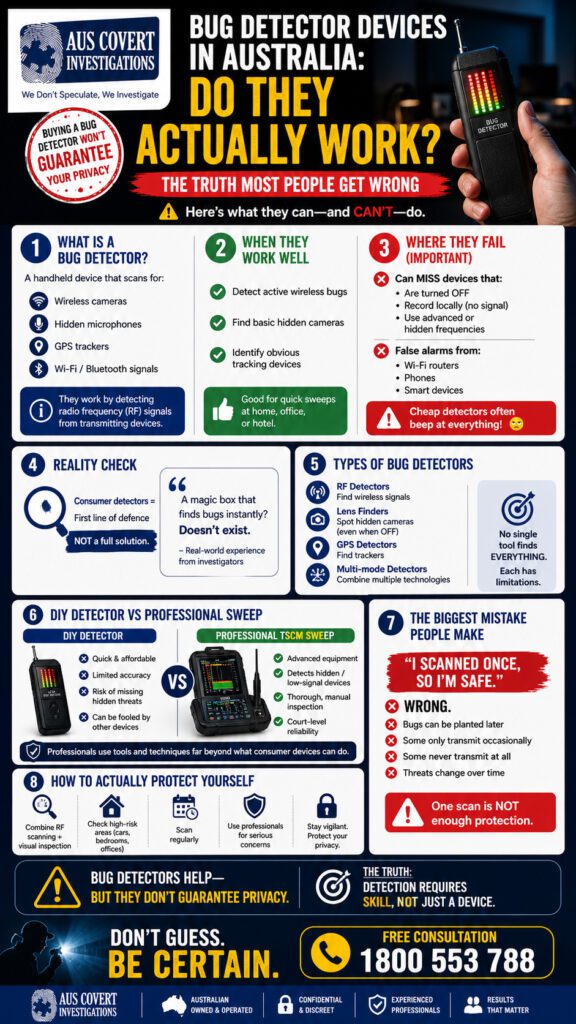
A bug detector is a portable counter-surveillance tool used to find hidden recording devices. In practice it’s a handheld RF (radio frequency) scanner that sweeps an area for suspicious signals. Essentially, you use the detector to scan rooms, cars or offices; when it senses an electronic bug (camera, microphone or tracker) it alerts you with lights or beeps. Modern bug detectors are built to find hidden spy cameras (wired or wireless), covert listening devices (audio bugs), and GPS trackers, as well as any transmitters on Wi-Fi, GSM, Bluetooth or other RF bands. Under the hood, most detectors scan a broad frequency range and listen for the characteristic signal of a device. Bug detectors work by scanning the environment for various frequencies used by surveillance devices,” detecting both RF transmissions and audio/EM emissions. In short, with a bug detector you actively sweep a space for hidden electronics that might be spying on you.
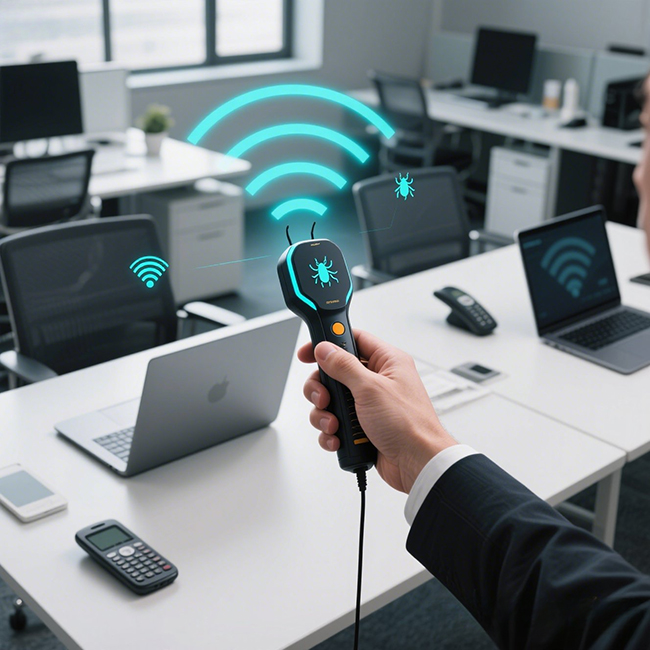
A handheld RF bug detector is used to scan rooms or vehicles for hidden wireless cameras, microphones or trackers. When the device senses a transmission in its frequency range, it alerts the user (via LEDs, sound or vibration).
Types of Bug Detectors Available in Australia
There are several categories of detectors, many of which are sold by Australian suppliers.
Common types include:
- RF Bug Detectors (Wireless Bug Finders): These scan for radio-frequency signals emitted by wireless cameras, microphones, GSM bugs, Wi-Fi devices, etc. For instance, RF detectors will pick up the RF link of a hidden wireless camera or “bug” mic. (As one guide notes, RF detectors are “designed to detect those devices that emit radio signals, such as wireless cameras, audio bugs, and wireless microphones”.)
- Audio/Bug Listeners: Some detectors specialize in listening devices. They are tuned to the frequencies or audio emissions of hidden microphones and “bugs.” In other words, they help you find covert recorders by picking up any RF audio transmission or sometimes just by detecting an active microphone circuit.
- Hidden-Camera/Lens Finders: These are designed to locate concealed cameras, even when those cameras are not transmitting. They typically use an infrared or laser light and a special viewfinder to make camera lenses flash. We call these “Hidden Camera Lens Finders,” which “use infrared or laser reflection to visually locate concealed camera lenses, even if the camera is off”. (Smartphone apps follow a similar principle by looking for infrared LEDs or unusual lens glints on the camera screen.)
- GPS Tracker Detectors: These devices specifically hunt for hidden GPS tracking units (often on vehicles). They scan for the particular frequencies or signals emitted by trackers. GPS tracker detectors scan for specific signals emitted by trackers and help you identify if you are being tracked without your consent.
- Cell Phone/Signal Detectors: Some units will detect active cell phones or Bluetooth/Wi-Fi devices in the area. These can alert you if, say, someone left a phone or tracker in your meeting room that is transmitting data. There are also multi-mode scanners that combine RF, Bluetooth/Wi-Fi and even magnetic field detection, so you can catch modern trackers (like AirTags, SmartTags, etc.) as well.
Each type has a specific purpose. In Australia you can buy these consumer detectors online or at security shops. Many are marketed for home and travel use. (Some advanced “professional” tools, like Non-Linear Junction Detectors, are generally only used by trained sweeps and are not typical consumer gear.)

Comparing Handheld Detectors vs. Professional Gear
In general, consumer handheld detectors are affordable and easy to use, but they have limitations. Professional counter-surveillance equipment is far more powerful and sophisticated. As AusCovert’s security analysis points out, “while consumer-grade RF detectors and bug detector apps offer basic protection…professional bug detectors are indispensable” in high-security situations.

The key differences include:
- Detection Range & Sensitivity: Professional units cover a much wider frequency range and can detect very weak signals. They often include multi-band scanning that consumer models lack. For example, professionals use RF systems and spectrum analyzers that sweep up to tens of GHz, and ultra-sensitive receivers to pick up low-power transmissions. Consumer devices typically only scan common bands (e.g. 50 MHz–6 GHz) and may miss a stealthy, low-output bug
- Additional Features: Pro equipment often includes specialized tools like directional antennas (to pinpoint a signal source), spectrum analyzers (to visually map frequencies), and NLJDs (non-linear junction detectors that find any electronic component, even in devices that are turned off). These features let professionals detect hidden electronics in walls or devices that a basic RF scanner would never see. In short, pros can detect “a wide array of surveillance technologies, including those that operate on multiple frequencies or utilize stealthy transmission methods”.
- Use Case & Expertise: Pros use these tools in sensitive environments (corporate espionage checks, legal/forensic investigations, VIP security, etc.). They follow strict protocols (often called TSCM or bug sweeps) and know where bugs are typically hidden. A handheld detector is meant for a general user to do a quick scan, whereas professional gear is meant for thorough technical sweeps by trained investigators.
In practice, a handheld unit is good for a quick “smoke test” – it can alert you to obvious wireless bugs in a room. But if you truly suspect sophisticated spying, you’d want the pro gear. As AusCovert’s expert notes, high-end equipment is “particularly vital in environments where sensitive information is handled,” because “private investigators and security professionals…rely on professional-grade equipment to conduct thorough sweeps”. In short, think of consumer detectors as a first line of defense and professional sweeps as the heavy artillery.
How Accurate Are Consumer-Grade Detectors?
Consumer bug detectors can reliably find common, active wireless bugs in simple settings, but they’re not foolproof. Their accuracy varies by model and by the environment. In busy RF environments (with lots of Wi-Fi, mobile signals, etc.) cheap detectors often trigger false positives. They may also miss low-power or cleverly hidden devices. For example, reviewers note that basic detectors “may struggle to detect more advanced devices” – bugs that use unusual frequencies, spread spectrum or encryption. In practice, many users find that inexpensive detectors often beep due to non-bug sources and sometimes fail to alarm when a high-end bug is present.
As Qld Covert (an Australian counter-surveillance PI firm) cautions, “consumer-grade bug detectors can be useful for basic sweeps, but professional equipment offers significantly greater accuracy and sensitivity”. In short, expect a consumer detector to give you a rough idea of wireless signals, but not to guarantee a comprehensive sweep. False alarms are common, and silent hidden devices (e.g. a DVR camera on a shelf that isn’t transmitting) won’t be detected by RF alone. So treat a consumer detector as a helpful preliminary tool – it can suggest there is a surveillance device, but it cannot ensure you’ve found every threat.
Can Bug Detectors Find Hidden Cameras Too?
Yes and no. Many multi-function bug detectors include a hidden-camera mode, but its effectiveness depends on how the camera is set up. If a camera is transmitting wirelessly, an RF detector may pick up its signal just like any other wireless bug. But if a camera is off or recording locally, an RF detector alone won’t see it.
That’s why dedicated camera detectors use a different method: they shine infrared or laser light and look through a viewfinder. Any camera lens will reflect that light, “appearing as a bright flickering white spot” even if the camera is powered off. (In practice, this is similar to using a smartphone camera in a dark room to spot hidden camera IR LEDs.) AusCovert Investigations explains that “Hidden Camera Lens Finders use infrared or laser reflection to visually locate concealed camera lenses”. In other words, some bug detectors have a built-in IR light and you scan the room while looking through the device; the lens will glow.
Smartphone apps work similarly: they use your phone’s camera to reveal hidden IR LEDs that spy cams often use for night vision. For example, Digital Camera World advises travelers to “look for infrared lights – many compact cameras designed for night vision has built-in IR lights”. In practice, this means you can use a camera detector mode or app to find active lenses and an RF scans to catch wireless cams that are on. But no single detector can catch all cameras. A totally passive (non-transmitting) camera requires either a lens-finding tool or a very thorough visual check of all objects.
What To Look for in a Quality Detector.
If you’re buying a detector, focus on the features that experts recommend. In general, the better units have:
- Wide Frequency Range: A detector should cover as many bands as possible (from low MHz up through Wi-Fi/GSM ranges). This broad coverage means it can pick up more types of bugs. Remember, “Frequency Range” is a key factor.
- High Sensitivity: It must detect even weak signals. Adjustable sensitivity helps you tune out false alarms from far-away sources. The ability to detect weaker signals emitted by hidden devices.
- Multiple Detection Modes: Premium models often combine RF scanning plus dedicated camera-lens and magnetic detection modes. For example, some units let you switch between RF mode, IR-lens mode, and even a magnetometer for wired bugs. This versatility means you’re not relying on one method alone.
- Clear Alerts: Look for both visual (LED strength bars or numeric displays) and audible alerts. Discreet vibration or headphone output can also be useful.
- Portability and Power: A compact, lightweight design makes it easy to sweep on the go. Long battery life (preferably rechargeable batteries) is important so your device doesn’t die mid-sweep.
- Ease of Use: Simple controls and straightforward indicators are best for non-technical users. If it’s too complicated, you may misinterpret the results.
In summary, buy the best combination of these you can afford. In short, “Signal Range & Accuracy – frequency range – multiple modes – visual & audible alerts – rechargeable battery – discreet design” are all desirable. Avoid the cheapest “toy” detectors, and read reviews on range and accuracy. Often a mid-range unit from a known surveillance brand will out-perform a no-name gadget.
Why You Still Need a Professional TSCM Sweep
Even the best consumer detector can’t match a full professional counter-surveillance sweep. Experts use a suite of high-end tools (spectrum analyzers, NLJD units, precision antennas, etc.) and proven procedures. They also know how to validate findings and avoid false positives. In any situation involving legal risk or sensitive information, hiring a licensed TSCM (Technical Surveillance Counter-Measures) team is strongly recommended.
Professionals rely on their gear to “conduct thorough sweeps of locations, ensuring that no hidden devices go undetected”. AusCovert Investigaitons’ TSCM services use “pro-grade RF and NLJD equipment” and cover homes, offices and even vehicles. In other words, they bring hardware far beyond a consumer scanner, plus the training to use it. This matters because adversaries may have planted bugs with obscure frequencies or with no active transmissions; only professional detectors (and techniques like physical inspection and signal triangulation) will find those.
For example, a pro team would sweep the building while monitoring the RF spectrum in real time and possibly use an NLJD to detect hidden electronics in walls or devices. They often sweep both RF and non-RF (wired or recorded) threats. In sensitive environments “professional equipment offers significantly greater accuracy and sensitivity”. In short, a certified bug sweep is the only way to be sure you haven’t missed anything.
If you suspect serious surveillance or just want peace of mind, consider hiring a specialist. In Australia, companies like AusCovert Investigations offer professional bug-sweeping services using advanced TSCM gear. They emphasize comprehensive, confidential sweeps for homes, offices and cars. While this is more costly than DIY, it may be worthwhile when your privacy or business secrets are on the line.
Best Practices for Using Detectors at Home or Office
When doing your own sweep, follow a methodical process:
- Baseline Check: First, with no special bugs present, note the normal background signals. For example, turn off or remove any known transmitters (Wi-Fi router, phones) and do a quick scan. This helps you distinguish normal signals from suspicious ones.
- Systematic Sweep: Slowly walk through the space with your detector. Scan each room or area from corner to corner, keeping the detector moving. Focus on likely hiding places: check light fixtures, smoke detectors, wall outlets, lamps, furniture crevices and desk equipment. In meeting rooms or bedrooms, sweep under and around the furniture. In offices, also check conference tables, credenzas and cubicles. If you have a multi-mode detector, switch between RF mode and camera-lens mode as you go.
- Investigate Alerts: Whenever the detector beeps or the signal bars rise, stop and inspect that spot in detail. Physically examine any suspicious item. Sometimes you can trace the signal by watching which direction makes the signal peak. Remember, some false positives (microwaves, wireless devices) are normal, so use common sense. But don’t ignore a persistent alert; something may be hidden inside (or near) that area.
- Check Vehicles and Personal Items: Don’t forget cars or bags. Bugs are often planted under dashboards or seats in cars. If you carry a briefcase or have an important purse, scan its seams and zippers. Also, when traveling or staying in hotels, sweep each new room before unpacking.
- Repeat Regularly: Make bug sweeps a habit in sensitive environments. AusCovert’s experts advise sweeping “regularly if you’re in a high-risk environment” – such as during sensitive meetings, legal work or if you suspect domestic espionage. A one-time check is not enough because a bug could be planted later.
- Avoid Common Mistakes: For example, don’t assume a more expensive detector is automatically better – features and tested performance matter more. Don’t scan only one spot – bugs can be anywhere. And ensure you keep the detector itself free of interference (e.g. charge it fully, and avoid sweeping near heavy machinery unless your account for it).
- Use Multiple Methods: Combine detector use with a good visual inspection. AusCovert Investigations recommends manually checking suspicious items and looking for unusual wiring or attachments. Also consider using smartphone apps as a supplement: apps can be handy for a quick IR-lens check of small rooms, but remember their limitations.
- Document Anything Found: If you do find a bug, remove it carefully and document it (take photos, note serial numbers, etc.). After removal, consider tightening security (change locks, encrypt communications, etc.) to prevent re-infestation.
By following these best practices, you can maximize the effectiveness of your DIY bug sweep. But always keep in mind the limitations of consumer gear. If you ever feel uncertain about the results, or if your detector reveals something suspicious that you can’t explain, it’s wise to get a professional to do a full sweep.
Key Takeaways
Bug detectors can help protect your privacy, but they’re not magical. A quality handheld unit (with a wide frequency range and good sensitivity) is a useful tool for quick scans. It can alert you to obvious wireless bugs or hidden cameras. However, consumer detectors often miss very stealthy devices or give false alerts in busy RF environments. Therefore, they are best seen as a first layer of defense. For critical situations, always rely on a certified counter-surveillance sweep. In Australia, firms like AusCovert Investigations specialize in professional bug-sweeping services – they use pro-grade RF scanners and junction detectors in a thorough, confidential sweep. In the end, combining diligent DIY checks with professional support provides the most reliable protection against hidden surveillance.
Browse Related Articles
FAQ