


Free Consultation at 1800 553 788
In the field of private investigations, there are two job descriptions that are prevalent but play a particularly important role in their respective areas: factual investigator and surveillance investigator. The definition of both terms is vital for any insurance company, business corporation, or legal professional, both for having the knowledge of investigator types and for the need to hire the right professional.
So, what sets them apart—and when is one more effective than the other?
Key Duties of a Factual Investigator
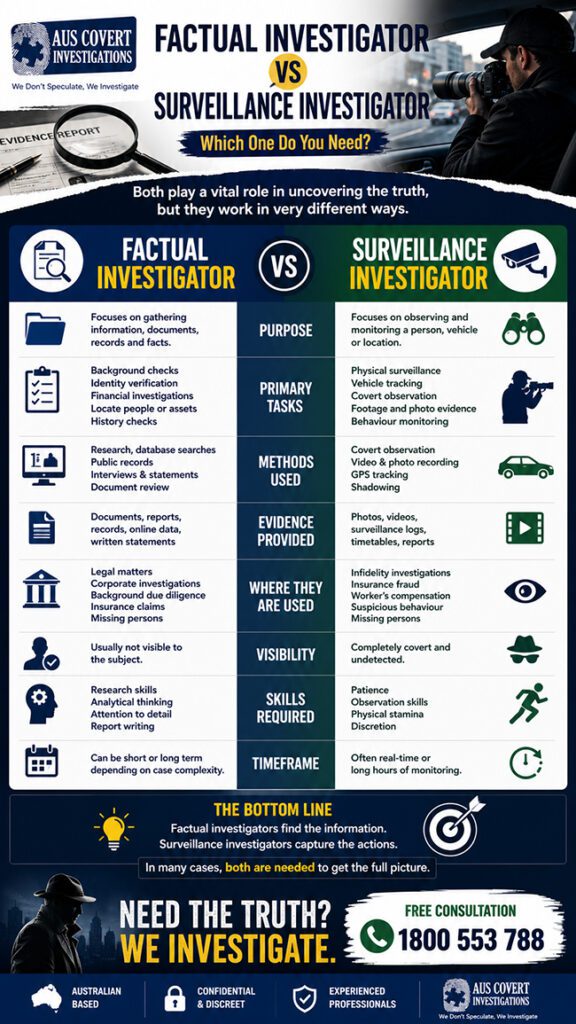
A factual investigator is the one who is responsible mainly for the collection of objective, verifiable information through interviews, taking statements, and the analysis of documents related to a case or an event. He/she is a person who conducts various investigative activities, following specific laws, and using good personal and research aptitude, while he/she does not act in a secret manner.
Common duties include:
- Conducting factual interviews with claimants, witnesses, employers, and other involved parties
- Reviewing police reports, incident records, and insurance documents
- Preparing comprehensive reports with signed statements and evidence logs
- Identifying inconsistencies, false claims, or missing data in case files
Investigators who work in the area of insurance, workplace injuries, legal liability, and corporate wrongdoing do a lot of factual investigation so as to gather information and evidence.
When a Surveillance Investigator Is Not Enough
Though the surveillance investigators are vital in terms of monitoring behaviour and collection of visual evidences, there are limitations. Observation is insufficient because it cannot give context, intention, and verbal confirmation, which is very important in legal or insurance situations.
Surveillance investigators:
- Track and record subjects through photos or video
- Monitor claimants suspected of exaggerating injuries
- Use GPS, hidden cameras, or stakeouts to observe activity
- Often work in personal injury, workers comp, or domestic cases
However, when written statements, face-to-face interviews, or court affidavits are necessary, surveillance cannot hold its ground and a factual investigator comes in to clean up the spaces.
Legal Boundaries and Compliance for Each Type
Both investigators are subject to state laws, professional codes of ethical conduct, though to be licensed and work all investigators are subject to these authorities and firms are not allowed to go against state laws.
- Factual investigators must ensure interviews are voluntary, recorded with consent, and properly documented to stand in court or claim evaluations.
- Surveillance investigators must avoid trespassing, invasion of privacy, or unauthorized tracking—breaches that can render evidence inadmissible.
In AusCovert Investigations, all our agents in whichever domain including surveillance and factual areas undergo tough compliance guidelines that are in compliance with NSW, VIC and Queensland license regulations.

The Role of Factual Investigators in Insurance Claims
Factual investigators play important roles in the insurance sector. Be it car accident liability, worker compensation benefit, or general personal liability, the insurers require documentation to determine the authenticity.
Factual investigators:
- Interview witnesses and claimants
- Cross-reference injury descriptions with medical and employment records
- Identify red flags, such as conflicting timelines or unverifiable incidents
- Draft comprehensive factual reports and signed witness statements
Insurance companies such as Procare are strongly using trained factual investigators but a lot of them are now soliciting the services of outside independent expert such as AusCovert Investigations to further examine and give objective reports.
Corporate Investigations: Why Facts Matter
Internal theft, harassment cases or any form of misbehavior on the part of an employee can be disastrous to any organisation in business world. A surveillance force may be able to tell about some suspicious activity, but a factual investigator will discover the purpose and the means of activity.
Typical corporate uses include:
- Conducting HR-related interviews during grievance procedures
- Investigating internal fraud or data theft
- Supporting compliance audits and safety investigations
- Obtaining employee and witness statements for legal defense
Factual investigation reports are legally documented, and hence they may protect a company against liability and enhance transparency within the company.
How Interviews and Statements Are Obtained
An important aspect of fact finding method is interviews. In contrast to interrogation, they tend to be conversational and neutral and it is done in order to obtain untainted testimony.
Factual investigators are trained to:
- Establish rapport to put interviewees at ease
- Ask open-ended questions to elicit more detail
- Use audio recordings and typed statements
- Ensure legal compliance and informed consent throughout
Then these statements are confirmed, signed and included in a wider statement of fact – usually sent to an insurer, law firm or an employer.
Choosing the Right Type of Investigator for Your Case
Here’s a simplified guide:
Your Case Type |
Use a Surveillance Investigator |
Use a Factual Investigator |
|
Suspected injury exaggeration |
✅ |
✅ |
|
Insurance claim verification |
❌ |
✅ |
|
Domestic or partner suspicion |
✅ |
❌ |
|
Corporate internal fraud |
❌ |
✅ |
|
HR grievance or misconduct |
❌ |
✅ |
|
Legal statement for court |
❌ |
✅ |
|
General suspicious activity |
✅ |
❌ |
In case your case requires some evidence of a definite nature, either swimming in interviews, documentations or even signed statements, a factual investigator would be your option.

The AusCovert Advantage in Factual Reporting
At AusCovert Investigations, we specialise in independent factual investigation services across Australia. Unlike generic firms, we deliver:
- Australia-wide coverage, including NSW, VIC, and QLD
- A team of licensed factual investigators with legal and insurance backgrounds
- Fast turnaround, discreet reporting, and full transparency
- Expertise in both corporate and insurance-related factual interviews
- Competitive pricing compared to larger agencies like Procare
If you are an insurer, a business or a legal company, our objective reporting will create clarity, accuracy and peace.
Conclusion
Although factual and surveillance inquirers serve truly useful purposes, their strategies, results, and utilizations are considerably different. A factual investigator adds legal authority, transparency and first hand testimony to the case in contrast to a surveillance investigator who gives observation evidence.
Depending on a type of your case, your legal necessities and the result you expect, either one will be a suitable option to restrict to, and in most circumstances, it is the most intelligent approach to use a combination of both.
FAQ