


Free Consultation at 1800 553 788
What You Need To Know About Private Investigator Law In Australia
Private investigators (or PIs) are the men and women of mystery. They act for various reasons outside public law enforcement. In Australia, various rules and regulations govern it, mainly in New South Wales (NSW). They ensure that investigations are legal and ethical. This article examines the basis of private investigators in NSW, including their licenses) and then cover off on all you need to know about their role relative to laws such as privacy, working with law enforcement and more. AusCovert Investigations, a top Sydney PI agency, prioritizes legal compliance. They also offer the best investigative services.
Licensing and Certification Requirements
A licence must be obtained from the NSW Police department in order to carry out investigative work legally as a private investigator. The key requirements include:
Training: Certificate III in Investigative Services (Private Investigator).
Background Verification: A well-detailed criminal history check to confirm job-fit of the candidate.
Experience: Some licensing categories may also ask for evidence of experience in the field.
Application: Submission of a long application form along with the necessary fees.
The licensing ensures that only qualified, reliable people can investigate. This will uphold the profession’s credibility.
Legal Authority and Restrictions
The powers of NSW private investigators and their limitations they are authorised to:
Surveillance: PIs can spy on an individual within legal limits to collect information.
Collect Evidence: As long as it is legally acquired, PIs can also collect evidence that will pertain to any case they may be working on.
But they need to comply with several constraints in that regard, such as:
No Arrest: Private investigators do not have the law enforcement power, so they can’t arrest people and access facilities.
No Trespassing: Private Property, No Trespassing (not to enter without permission)
No Impersonation: PIs cannot impersonate law enforcement or other officials.
It is important to be aware of these restrictions in order not to get into legal troubles and conducts investigations ethically.
Privacy Laws & Regulations
Privacy is a huge concern for private investigators. A PI must also comply with the Privacy Act 1988 (Cth) and/or Surveillance Devices Act 2007 (NSW). Key points include:
Surveillance: A PI must not conduct illegal surveillance, e.g., bugging without consent.
Data Protection: All individual data should remain confidential and secure.
Consent: In some situations, PIs may need to have consent before gathering information from you.
The rules protect the privacy of those involved. They also keep investigations within legal limits.
Confidentiality and Client Rights
The privacy needs of private investigations Clients have the right to:
Privacy: To keep their personal information confidential and safe.
Transparency: Understanding the investigation process and results

Assuring Legal Compliance: They can rest easy knowing their case is being taken care of in the most lawful way.
We will do everything to protect you when using AusCovert Investigations. We will lead by example on client confidentiality and obey the laws that govern your rights.
Case Study: Legal Challenges as Part of an Investigation
For instance, the client needs someone to investigate a suspected employee fraud and hires a PI. This case consists of many legal challenges for the PI during investigation:
Unauthorized Retrieval of Private Information: Collect personal data only if it is legal and consensual.
Surveillance Threshold: Ability to surveillance without violating employee privacy. Specifies needs for relocation or transfer.
Admissible Evidence: Capture of evidence in a way that is recognized by court as acceptable.
However, you can still conduct a successful investigation. Do this by carefully working your way through these challenges within the legal framework.
Cooperation with Law Enforcement
Investigators frequently work with the police. That can be through:
Sharing Information: Private investigators may need to give a law enforcement agency evidence or information for their investigations.
Joint Operations: Collaborating with police on investigations when criminal activity is suspected.
Consultation: Asking law enforcement for advice on a legal or procedural issue.
It also does a lot to keep your private investigation practices in line with the law as well.
Now, let’s discuss about “Affairs of the Heart.” It will be from a PI’s view and discuss some ethical boundaries of private investigation.
Ethical Boundaries in Private Investigation
While ethics play nearly equal role with the law in private investigation. PIs will have to follow ethical frameworks like:
Honesty: Giving proper and honest information to clients and the authorities.
Integrity: Investigating with the highest level of integrity for all parties involved.
Unbiased: Staying unbiased and neutral during the investigation.
Ethical Limitations protect integrity and fairness in investigations.
Technology and Legal Synergies
Tech in investigations raises legal issues. GPS tracking, digital forensics, and cameras can only be used within the law.
GPS Tracking: Typically requires individual to give consent or a legal reason for tracking movements of that person.
Digital Forensics: Complies with the law of access and privacy in data.
Surveillance Cameras: Allowed only in public areas, not where privacy is expected (e.g. bathroom/bedroom).
PIs must keep up with new tech and laws. Otherwise, the weeds will swallow them whole.
Gathering Evidence Legally
To be admitted in court, the evidence gathered from any investigation should have legally obtained. This involves:
Preserving Evidence: Ensuring evidence is collected per legal procedures and standards.
No Illegal Activities: Refrain from hacking and any other activities that are illegal.
Documentation: Must be documented in order to verify how the evidence was obtained and establish its legitimacy.
Through all of this, the legal acquisition of evidence gives it extra credibility and better standing in a court case.
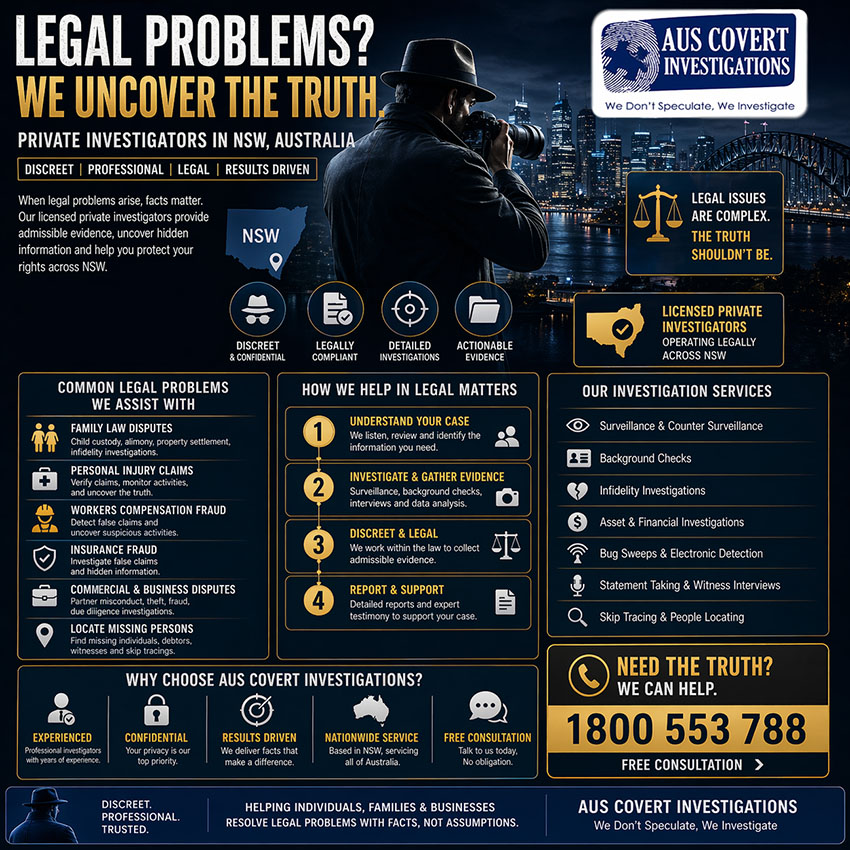
Laws and Regulations Related to Surveillance
Surveillance is a tactic used by most private investigators, however it’s one of the more regulated services in the PI industry. Key regulations include:
Surveillance Devices Act 2007 (NSW): It covers using listening, optical, and tracking devices.
Consent Requirements: Most cases require consent to use surveillance devices, especially for audio recordings.
Public vs. Private Spaces: Privacy Guidelines are different for public versus private locations
You must follow such laws to avoid legal trouble. Your investigation results must be legal evidence.
Real Life Legal Cases With Investigators
A few such instances from real life remind us the kind of legal cases and implications that a private investigator needs to go through:
Case 1: A PI was hired to catch a cheating spouse. The evidence (video footages) was thrown out in court as it had been gathered via illegal surveillance.
Case 2: Investigators are cracking down on a countrywide fraud case. They used a search warrant to access public records and legal surveillance.
This shows the need for preliminary investigations in criminal law. They ensure evidence is not obtained incorrectly and in breach of your obligations.
Resolving Legal Disputes
There are also potential legal fights during or after an investigation. Resolutions of these disputes include:
Legal Counsel: Contacting a lawyer to help resolve disputes.
Documentation: It is all the evidence supporting the investigation’s legality. It is extensive.
Mediation: Resolving disputes through mediation before taking legal action.
This ensures that legal disputes are handled and resolved. It should interfere as little as possible with the investigation.
The Role of Legal Counsel
Legal advice is even more valuable in private investigations.
By advising on: Suggest guidance around all legal & statutory compliance
Review evidence: Making sure that the way underground with legally proceeded gathered.
Representing in disputes: Representing investigator or client for legal disputes.
Collaboration legal counsel helps PIs with complex legal issues. It ensures they are operating within the law.
Reports and Documentation Requirements
Private investigations require proper reporting and documentation Requirements include:
Detailed Reports: Clients want detailed reports. They should explain not just what happened in the investigation. They should also say why one witness is less reliable than another with a different recollection. Collectors are time-bound, and many companies have SLAs. This made it hard for operations to manage their workloads.
Evidence Logs: Comprehensive logs of all evidence found, how and when it was retrieved.
Compliance Records: Record keeping to evidence conformity with laws and industry standards.
Concise, complete reports boost an investigation’s credibility. So, supporting docs are essential.
Legal Recourse for Clients
If clients believe an investigation was unprofessional, they can pursue legal action. This can include:
Lodge complaints with the NSW Police Force and other relevant regulatory bodies.
Going to court for violating their rights
Requesting Audits: Any request for an audit of the investigation process for compliance.
It is vital to give clients a clear way to seek redress. This will maintain trust in the investigative process.
Continuing Legal Education
Continuing education is vital for private investigators. They must know of changes in laws and practices. This includes:
– Workshops and Seminars: Organize or attend workshops on recent changes in laws.
– Professional Associations: Associations that provide resources, training in legal issues etc.
– Legal Publications: Staying up on publications and journals regarding legal trends, case law.
Continuation education is undertaken to try and ensure that the PI keeps up with current laws.
5 Common Legal Mistakes to Avoid
Common Legal Pitfalls In Private Investigations
– Improper Surveillance: Spying without proper consent or legal base.
– Improper Evidence Handling: Wrongly handling evidence which makes it inadmissible.
– Breach of Privacy Laws: Meet against any type of private privacy law is lead to lawsuit.
Preventing these errors requires a deep knowledge of law, training and attention to detail.
Conclusion: Navigating the Legal Landscape to Your Best Advantage
It is important to know the basics of operating as a private investigator in NSW. Legal compliance is a must. This includes, licensing, privacy laws, and keeping records. AusCovert Investigations, a licensed private investigation company prioritizes legal and ethical practices. We ensure our clients get professional, lawful investigative solutions. Private investigators must know and be vigilant. Only then can they navigate the changing laws to serve their clients.
FAQ